
A Defense of “A Christmas Story”
It has recently been brought to my attention that there are a number of folks who do not enjoy the 1983 Christmas classic, A Christmas Story. I will speak no unkind word about those people. They have their reasons for disliking the film and I am content with differing opinions on something like this. But I would like to present my perspective about the film in hopes that perhaps a few of those detractors will reconsider their strongly held views.
First, allow me to present some of the criticisms of the film. I hope I do justice to these views as I do not share them, but it would be unfair of me to trot out a strawman that is easily taken down with logic and thoughtfulness. I will bullet point these for ease of reading and organizational clarity:
- A Christmas Story lacks joy.
- A Christmas Story lacks innocence.
- A Christmas Story lacks humor.
In the following paragraphs, I will elaborate on each of these points, at least as best as I understand the complaints, and lay out my reasons for why I believe they are wrong. This will not be a review or summary of the film. I am operating under the assumption that if you are reading this, you have seen the film and remember the basic plot points and the primary characters. Let’s dive in.
Criticism 1: A Christmas Story Lacks Humor.
I will tackle these in reverse order, from what I view as the easiest to most challenging. First, let’s deal with the so-called lack of humor. In some ways this is the easiest to address, as I can point out multiple examples of the film’s sense of humor. But as humor is incredibly subjective and dependent on each person, things get a little more complicated.
If you do not enjoy the humor of A Christmas Story, there isn’t much I can write that will change your mind. You either vibe with the film’s comedic sensibilities or you don’t. Personally, I find the film to be full of wonderful moments of humor, some big and broad and others more subtle. The more overt moments include Randy (Ralphie’s, the protagonist, little brother) and his ridiculous winter attire. The “triple dog dare’ and the frozen tongue on the metal flagpole. The Christmas turkey being devoured by the Bumpus’s dogs. Ralphie’s ridiculous daydreams. Or the Leg Lamp and all the scenes involving it.
I find all of those moments humorous on varying levels, depending on my particular mood when watching the film each year. (Yes, I watch it every year.) But the element of the film that I find most endearing and hilarious, is in the narration. A Christmas Story is told with the articulation and verbal sophistication of an adult but through the mind and lens of a 9-year-old boy. That is a difficult storytelling device to pull off, and other films have tried and failed, but A Christmas Story handles it with boundless levels of wit and humor. Every time I watch this film, the narration’s wordplay and charm make me smile and laugh.
Criticism 2: A Christmas Story Lacks Innocence.
Next, let’s spend a few minutes on A Christmas Story and it’s supposed lack of innocence. I have to be completely transparent here. I don’t entirely understand this criticism. Perhaps it’s the family dynamics – with the distant and mostly grumpy father, the subservient and meek mother, or Ralphie’s desire for a toy gun. Or maybe it’s some combination of all those things as well as the general lack of cuteness. Or perhaps it’s that the film has no climactic moment where everything works out and all is picture perfect.
I would argue that those things make for a better story. In fact, it’s one reason why the film works as well as it does and why it has become a Christmas favorite for so many. It feels much closer to reality than many other Christmas movies that ply their trade with sunshine and happily ever afters. Yes, Ralphie gets his toy gun, and he considers it the best Christmas present he ever received. But he does nearly shoot his eye out, he breaks his glasses, and then their family Christmas feast is ruined by rowdy and hungry dogs.
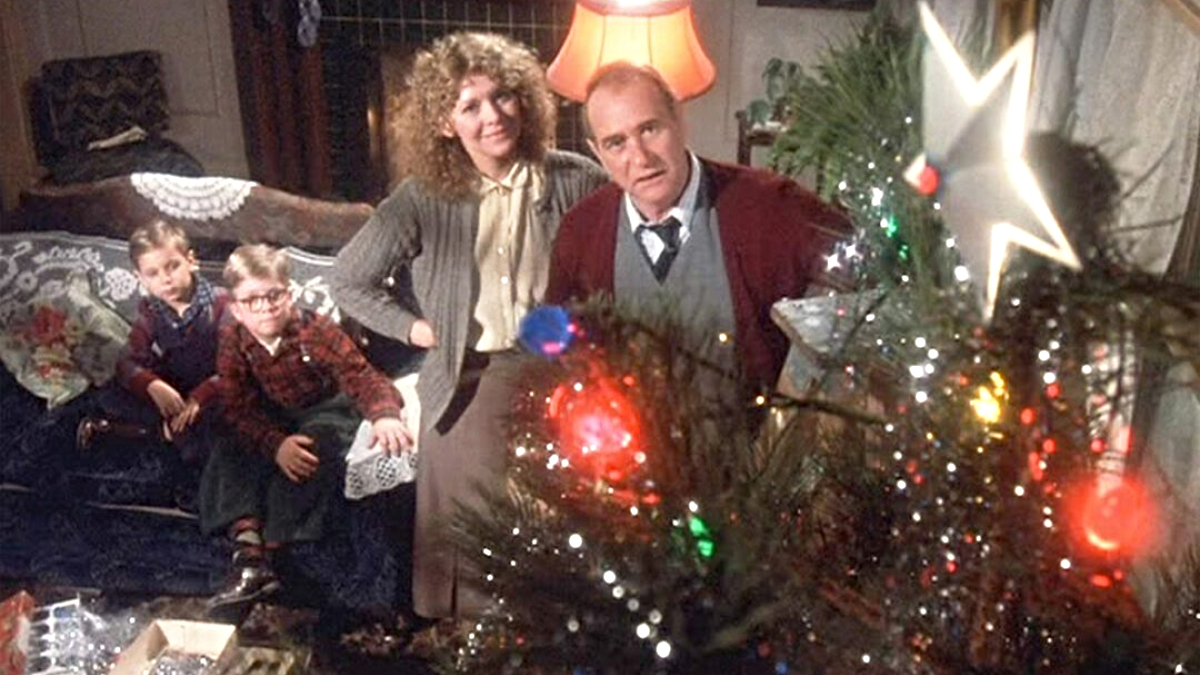
I don’t believe any of those things speak to a lack of innocence. I think they point to the true-to-life, Christmas ups and downs that most families experience. And in spite of the partial dysfunction on display, the family shares a warm-hearted Christmas morning, basking in the glow of the Christmas tree and the happiness of being together. It was a messy journey to that moment, and there is mess to follow, but there is a blessed sense of familial contentment that saturates that scene which speaks true to my heart. And it resonates with so many viewers because we see ourselves in it.
Criticism 3: A Christmas Story Lacks Joy.
Finally, we will deal with the lack of joy. I assume that this is in reference to the film’s understated tone. Not that the film is entirely this style – we do get the various over-the-top daydreams, the Leg Lamp, and the department store Santa Claus. Yet at its core, A Christmas Story is meant to recreate the feel, ambiance, and naturalism of the 1940’s era it is capturing. Home life is a bit bland, a bit disordered, and just recognizable enough to help audiences see the world through the eyes of a completely average 9-year-old boy.
The film is set in a very different moment in time than most viewers are familiar with. One we do not recognize, except through what we’ve seen on film and television. And in most representations of that era, life is not always as nondescript as what we see in this film. A Christmas Story’s version of life is not picture perfect. It’s no Hallmark movie or Norman Rockwell painting. The Christmas tree is a little wonky. The house’s furnace constantly goes on the fritz. The youngest child won’t eat. The parents clearly love each other, but there is a definite emotional distance between them that modern audiences could find off-putting.
The boys are rough and tumble. They fight. They play with toy guns – something every boy I grew up with did as well, and that being 40 years later than the film is set. (Your experience might be different, but this desire for and fascination with toy guns is something I, and all of my friends, shared.) There are bullies and bloody noses. And there is a weird department store Santa and scary elves.
All of these elements feel true to life and completely consistent with the way things would have felt and seemed to a 9-year-old boy in that era. And the film does not shy away from them or attempt to whitewash the absolute averageness of everything we see. But as each vignette is presented, and we move closer to the film’s finale, the film drops little breadcrumbs of light and joy.
When Ralphie finally has enough and fights back against the neighborhood bully, it’s his mother who finds him. Based on what we’ve seen from her character up to that point in the film, we expect her to overreact and severely punish Ralphie for fighting and swearing. Instead, she comforts him. And she decides to not mention it to her husband and to let the matter die then and there. It’s a clear bonding moment between mother and son and it allows Ralphie to see his mother in a brand-new light.
As I mentioned previously, I adore the Christmas morning scene. If you chose to view this family as cold and joyless, this scene proves you have completely misinterpreted everything. The boys are thrilled, even Ralphie. Yes, there is a slight disappointment that he didn’t get his Red Ryder Carbine Action 200-shot Range Model air rifle, but he is still happy and content. And the parents are more than happy to watch their children feverishly unwrap each new present. Their joy is palpable.
But the moment that ties A Christmas Story together, and one that I believe most powerfully speaks to the heart of the film, is the final scene in the Chinese restaurant. After the Bumpus hounds ruin Christmas dinner, the old man (the father) makes the decision that they are going out to eat for Christmas. They end up in a Chinese restaurant, likely the only place open on Christmas day. The scene is played for comedy, as the family listens to “Jingle Bells” being sung hilariously and as they look on in shocked laughter as their Christmas duck is beheaded right in front of them. But something more profound than comedy is winding its way underneath the jokes.
The family laughs. They smile. Their Christmas day has been completely derailed and not gone how any of them would have hoped or expected. But they are happy. There is a joyful spirit in the air. And I guarantee, this Christmas is the one they will remember for the rest of their lives. This moment is fully earned because the rest of the film feels as unremarkable and ordinary as it does.
If you miss this when watching the film, I beg you to give it another shot to see it through new eyes. A Christmas Story makes no attempt to sanitize our holiday mishaps and dysfunction. It is unvarnished and down-to-earth. Yet, even with no sugarcoating or rose-colored lenses, A Christmas Story envisions a reality that even at its most mundane and banal, is full of laughs, love, and joy. It is a deep-rooted joy that resonates in my heart every Christmas, no matter how difficult or “boring” my year has been.
As for me and my family, we will continue to enjoy A Christmas Story each and every year.

- Every NEEDTOBREATHE Title Track, Ranked - March 18, 2026
- Go Do Things - February 26, 2026
- 2025 Music Review - February 2, 2026
Discover more from Rambling Ever On
Subscribe to get the latest posts sent to your email.

It would be difficult to argue with your logic, analysis, and recall of detail and recall. Good article!
The narration is brilliant and has strong Twain vibes.
I love A Christmas Story!