
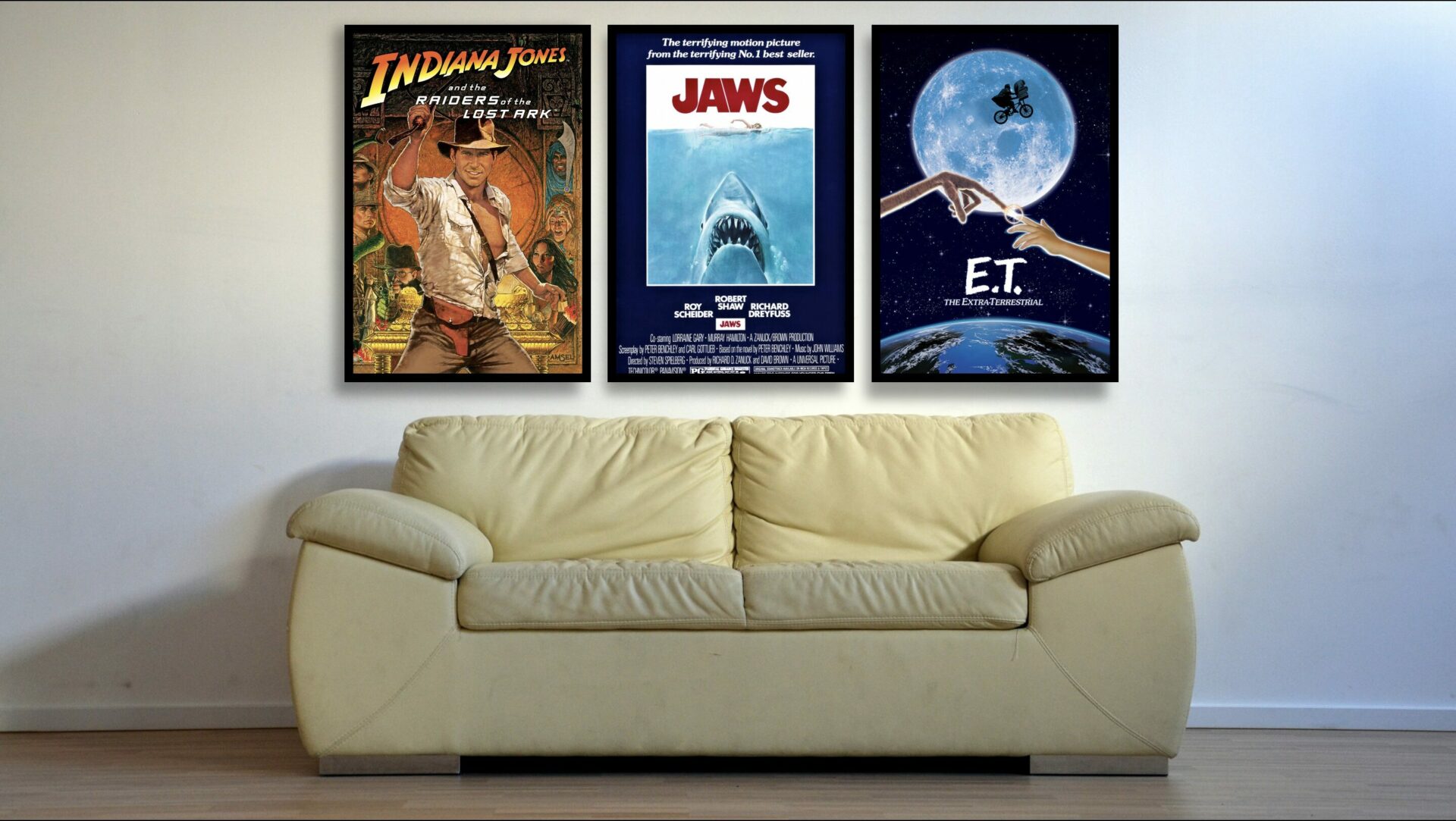
Celebrating Steven Spielberg
Introduction by Aidan Lytle
No director has had a bigger influence on Hollywood, the box office, and the American cinematic conscience than Steven Spielberg. His mastery of multiple genres, the most notable being science fiction, adventure, and historical dramas, is second to none. The impact he has had, not only on other directors to follow him, but also on the general American cultural imagination cannot be overstated. Spielberg speaks the language of film more fluently than anyone, and his love for it pours into everything project he’s made.
Over the last couple of months I’ve gone back through Spielberg’s entire 35 film catalog. The experience has been wildly rewarding, and I am glad to have walked through this one director’s entire body of work, seeing how he’s improved as a filmmaker and understanding the scope of his unmatched career.
With the release of Disclosure Day, Spielberg has found himself at the forefront of conversation once again. Rather than ranking all 35 of his films, or even doing a top 10, we decided to add to the conversation by highlighting a handful of his films that have been impactful to us, some being his classics and others the more under the radar ones. We hope you enjoy and we’d love to hear your favorites as well.
Raiders of the Lost Ark (1981)

If my memory is correct, I first watched Raiders of the Lost Ark in 1985. My parents had recently purchased a VCR and we rented 5 movies as a family. Raiders was the best of the 5 and is one of my all-time favorite films. Not only did Spielberg and company launch one of most beloved and enduring franchises in cinematic history, they also created the template for the modern action/adventure movie.
Raiders is tight, crisp, funny, and never boring. Nothing is wasted in the 115-minute run time. Every scene matters, every line packs a punch. Next time you watch it notice how something big/exciting/important happens every 10 minutes. Many lesser movies have copied the Raiders formula, but none of them were able to recreate Raiders‘ heart.
All of this goodness culminates with people’s faces melting because they opened the ark of the covenant. Not only was the face melting cool and a little bit scary when you are a kid, it also taught us to respect what God said in the Old Testament about how to treat the ark. Raiders is the best Indiana Jones movie, and a top 3 Harrison Ford film, which is saying something when you consider his impressive career. Threw in John Williams’ iconic soundtrack and you’ve got the recipe for an all time great film. The fact that Spielberg directed this and E.T. back-to-back blows my mind. Talk about a hot streak. (Michael Lytle)
E.T. The Extra Terrestrial (1982)

I believe E.T. is Spielberg’s best, and it’s not even close. Every shot is breathtaking, to where even the basic shots of the house at night are beautiful: covered in fog and lit by moonlight. And the beautiful shots are accompanied by a transcendent movie score; John Williams is the undisputed GOAT of movie soundtracks. The song The Magic of Halloween makes an already fantastic scene into one of the coolest scenes in all of cinema.
The writing is also perfect. Spielberg actually knows how to write and direct children. Movies nowadays have kids speak more coherently and intelligently than most adults. In this movie, you have kids insulting and trash-talking each other, using crude teenage boy humor, rather than every scene being serious and personal for no good reason, which makes this movie actually enjoyable. You only get serious conversations between the kids when the scene calls for it, e.g. talking about their father. Spielberg perfectly blends the immature goofiness of teenagers with serious conversations between them because, after all, they still have feelings, but there’s nothing wrong with them still being childlike.
A good piece of art inspires future masterpieces. The Lord of the Rings helped inspire basically every fantasy story after it came out. Star Wars helped inspire other space movies and pushed people to become filmmakers. And E.T. has inspired so many amazing movies and TV shows, some of which are my absolute favorites: The Iron Giant, Super 8, and in a way, Stranger Things. This movie is perfect in every way, shape, and form, and has held up perfectly these past 40+ years and will continue to hold up for 40 more. (Wesley Lytle)
Schindler’s List (1993)

To the best of my recollection, I’ve seen Schindler’s List four times in my life. Spielberg’s unflinching look at the Holocaust is an almost overwhelming experience. While I consider it to be one of the most important films ever made, I wouldn’t call it one of my favorites. Yet I deeply respect and admire it. Spielberg is operating at the peak of his dramatic capabilities, and the film is a testament to his skills and artistic vision. But it is also as heavy of a film as I have watched, and it is not one I return to often.
This all speaks to both its difficult thematic content as well as its transcendent power. Schindler’s List is one of a handful of films I consider to be mandatory viewing. It is an important reminder of the darkest depths of the human soul as well as the luminous Imago Dei that flickers in each of us.
I’ll leave it at this. Steven Spielberg has directed 35 films, many of them iconic and game changing. But the story of his career could not be told without Schindler’s List. It is that vital to who he is as a director and as a man. (Phill Lytle)
War Of the Worlds (2005)

I have not read the novel or seen the 1953 movie version, yet I doubt either could blow me away more than this film does. It’s interesting because despite the fame of the novel, and Tom Cruise starring in it along with Spielberg’s direction, this movie still feels underrated. But as far as enthralling an audience for two hours with good cinema, it should be highly rated to me.
I feel for Ray and his kids essentially from the beginning. Even though Ray clearly has brought most of his problems on himself. Maybe it’s just how good an actor Cruise is. But that matters because the movie jumps into the horror pretty quickly.
From there it’s just a superb blend of visual art and angst and action. I appreciate the movie for being terrifying at times without being gory. In fact, I’d say the jump scares aside, this movie is more nerve-wracking than Signs and that is intentional. It doesn’t let up much and even when it’s not the aliens terrifying the audience, it’s the human response. It’s so real and raw and borderline hopeless. But it pulls it together at the end and at that point I exhale and appreciate the ride I just went on.
I saw this twice in the theater which is quite rare for me and extremely rare if you take out my favorite movies of all time, like the Rocky saga and Dumb and Dumber. But it captivated me that well. (Gowdy Cannon)
The Fabelmans (2022)

The Fabelmans is Spielberg’s autobiography, and in it he tackles the deeply personal and messy parts of his own story head on. We see him fall in love with movies and become completely enamored with how to make them. Structurally, Spielberg crafts The Fabelmans through incredibly unique yet powerful narrative arcs; as his love of film and his commitment to learning the medium grows, his parents’ relationship slowly devolves to the point of separation. It becomes clear that movies for Spielberg are more than a hobby—they are the medium by which he grapples with the world around him, and he is gifted enough to share that with his audience.
The life altering moment of his parents’ divorce that changed Spielberg’s entire life echoes throughout a lot of his work. We see these constant recurring themes of broken homes, the relationship between a father and son, and cinema as an escape all interwoven in E.T., Close Encounters of the Third Kind, Indiana Jones, War of the Worlds, Catch Me If You Can, and more. The Fabelmans, while not a particularly happy film, is full of fun references to so much of Spielberg’s filmography, and I catch more and more every time I watch it.
John Williams’ score is a soft, piano driven, moving work that is made all the more powerful in context of the work he’s done for Spielberg in the past. Michelle Williams and Paul Dano give career performances. The Fabelmans deals with deep themes that resonate more and more with every rewatch. It’s sentimental, but what else would you expect from a filmmaker who has made a career of some of the most hope filled films in history? It also ends with maybe my favorite final shot ever. (Aidan Lytle)
Jurassic Park (1993)

Steven Spielberg and John Williams have teamed up to create some of the most iconic movie moments in film history. E.T. Indiana Jones. Jaws. The list goes on and on. But if you really press me, I think Jurassic Park might be their most transformative collaboration. Before you object, hear me out.
Jurassic Park is not Spielberg’s best film. And it’s not John Williams’s best score. But together, they took something that could have been so easily a paint-by-numbers project – a film about dinosaurs in a modern amusement park – and they created something magical and revelatory. In lesser hands, this film would be in the bargain bin at Wal-Mart two months after it limped its way into theaters. But in Spielberg’s expert care, the film has a beating heart, an emotional through-line, and a sense of awe and wonder. The majestic music by Williams serves and elevates the final product in a way only the best creative partner could.
Jurassic Park is why we go to the theater. It’s big and bold and creates a feast for our eyes and ears. A movie about dinosaurs has no business being all of that, but Spielberg and Williams have never played by ordinary rules. They write their own rules, and we are better for it. (Phill Lytle)
Saving Private Ryan (1998)

Saving Private Ryan is Spielberg at his finest during his historical era. When the movie stormed into theaters, it was the most realistic war film ever created. That is still true today and will remain true for the foreseeable future. Saving Private Ryan doesn’t stylize, sensationalize, romanticize, or celebrate World War II. Rather, the film celebrates, honors, remembers, and respects the people who fought in it. The film is intentionally difficult to watch but leaves you changed by the experience. (Mark Sass)
Bridge of Spies (2015)

One of Spielberg’s defining genres is the historical drama. And while Bridge of Spies may not be as historically significant as Schindler’s List, nor as brutally intense as Saving Private Ryan, I find it to be an incredibly engaging and important political thriller. Tom Hanks gives one of my favorite performances in his legendary career, playing James Donavan, an insurance agent asked to defend an alleged Russian spy in court.
This is one of the better scripts Spielberg has had to work with in his career. The nearly 2-and-a-half-hour runtime flies by as we connect with Donovan, a man trying to negotiate with the enemy during the Cold War all while serving a country that hates him for defending due process. (Aidan Lytle)
Jaws (1975)

Steven Spielberg’s Jaws didn’t just invent the summer blockbuster. It changed Hollywood forever—literally. Before its release, theaters released movies in a roadshow format, starting primarily in major markets like Los Angeles and New York City, expanding their rollout through word of mouth. And then came Jaws, which created a box-office frenzy unlike ever before.
Eventually, Jaws unseated The Godfather as the top-grossing movie ever and was the first to crack the $100 million mark domestically (ultimately earning $450 million worldwide). And Hollywood took note that it could profit from movies in ways unrealized before. Stores began mass-producing Jaws T-shirts, action figures, and other merchandise. Also, for the first time, Hollywood started advertising movies on network television.
And all this came from a film that Spielberg believed would doom his career as a fledgling director. Most die-hard Jaws fans are familiar with the lore of the catastrophic filming experience in Martha’s Vineyard. Due to ongoing technical difficulties with the mechanical sharks and filming at sea, the shoot ran over schedule, from 55 to 159 days, exceeding the budget by 300%.
The 27-year-old director recounted, “I had a full-blown panic attack. . . . I couldn’t breathe, I thought I was having a heart attack.” Even after Jaws became a phenomenon, Spielberg woke up in bed sheets soaked with sweat, a result of nightmares about working on the movie.
But why does Jaws endure even 50 years later? The film famously created mass panic among beachgoers, leaving them forever afraid to swim in the ocean again. John Williams’ soundtrack remains ingrained in viewers’ subconscious. The poster is arguably the most iconic movie poster of all time.
And to top it off, Jaws is a bona fide masterpiece. It’s a rare popcorn film elevated by a terrific screenplay, great performances by Roy Scheider, Richard Dreyfuss, and Robert Shaw, and brilliant pacing and suspense. And despite all the gruesome scenes of swimmers becoming shark food, the most powerful scene is the brief interlude in which the three protagonists recount their battle scars at sea and Quint delivers a bone-chilling monologue about the fate of the USS Indianapolis.
So before you head to the beach this summer, be sure to revisit Jaws and reflect on how Spielberg’s film about a great white shark changed Hollywood forever. (Jared Austin)
And so many more!
We’ve highlighted nine of our favorite Spielberg films, but there are so many others we could write about. While Raiders of the Lost Ark is widely considered the best of the Indiana Jones franchise, you can’t go wrong with any of the original trilogy. Contrary to haters, we celebrate the darker-tinged insanity of The Temple of Doom. And the original closing act of that great trilogy, The Last Crusade, is as entertaining as any film from any era.
We could spill a lot of ink about the edge-of-your-seat thrill ride of Catch Me If You Can. Or discuss the smile-inducing joys of his family friendly fare like Hook or The Adventures of Tintin. And then there are the dramatic heavy weights. Amistad, Munich, The Post, and Lincoln all add to the cultural conversation in myriad ways. And if you are craving daring and intellectually sophisticated science fiction, Spielberg offers you Minority Report, Close Encounters of the Third Kind, and A.I. Artificial Intelligence.
The point being, Steven Spielberg has carved out a career that cannot be defined by one genre or one style. He has made action films, dramas, comedies, family films, sci-fi classics, and historical masterpieces. There is no director with more success with general audiences and film critics. It is an impossible tightrope to walk, yet Spielberg has done it with what looks like effortless grace and skill. Yet it is clear he has worked hard to hone his craft and sharpen his artistic vision. And this labor and the obvious fruit it has wrought deserve to be celebrated.
Let us know in the comments what your favorite Spielberg movies are. Thanks so much for reading!

- Embodied Fellowship: Attending God’s Community - October 1, 2026
- Celebrating Steven Spielberg - July 1, 2026
- Every Fast Food Chicken Restaurant, RANKED - June 18, 2026
Discover more from Rambling Ever On
Subscribe to get the latest posts sent to your email.

My faves:
E.T.
Raiders
Jurassic Park
Last Crusade
Temple of Doom
Schindler’s List
Saving Private Ryan
Munich